
How Should a Corporate Landing Page for Google Ads Be Structured?

A Google Ads landing page should match the visitor’s search intent, explain the service clearly, build trust quickly, and guide users toward one focused conversion action.
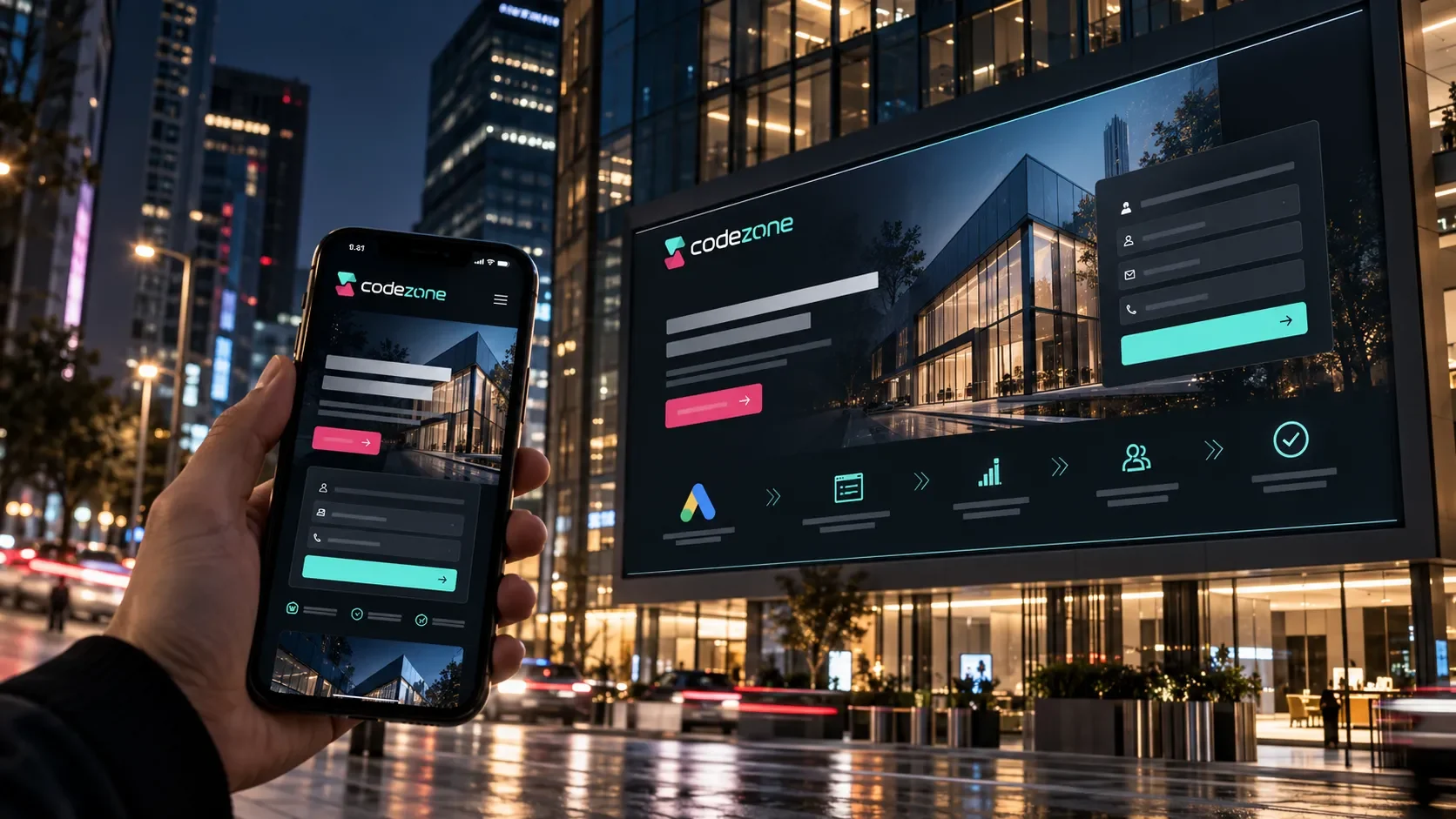
A visitor coming from Google Ads arrives with a different level of intent than someone casually browsing a corporate website.
They have searched for a specific service, clicked an advertisement, and arrived on the page expecting to find information directly related to that search.
The landing page should therefore help the visitor answer a few important questions quickly:
Am I in the right place?
Does this company offer the service I searched for?
Is this company credible?
Does the service fit my needs?
What should I do next?
A strong Google Ads landing page connects the campaign message, page content, trust signals, CTA structure, form experience, technical performance, and conversion tracking into one focused journey.
The goal is not simply to create another corporate page.
The landing page should turn relevant advertising traffic into measurable customer inquiries.
The Landing Page Should Match Search Intent
The first step is understanding why the visitor searched for the keyword in the first place.
Someone searching for:
corporate website development
has a different intent from someone searching for:
website design examples
The first visitor may already be evaluating service providers.
The second may still be researching ideas.
This distinction should influence both the advertising campaign and the landing page.
Before designing the page, the team should define:
Which keywords lead to the page?
What service is the visitor looking for?
Which stage of the decision process are they in?
What information will they need before contacting the company?
What should the primary conversion action be?
When search intent and landing-page content match, visitors can understand the offer more quickly.
The transition from advertisement to page also feels more consistent.
The Ad Message and Landing Page Should Continue the Same Conversation
The promise made in the advertisement should be visible when the visitor arrives on the landing page.
If the advertisement promotes corporate website development, the landing page should open directly around that service.
A visitor should not click a specific advertisement and arrive on a generic homepage where they need to search for the relevant information again.
The relationship can be structured like this:
Search Query → Advertisement → Landing Page Message → Service Details → Trust → CTA
The headline and supporting description should use language consistent with the campaign.
This creates continuity between what attracted the click and what the visitor sees afterward.
For example, if an ad focuses on:
Corporate Websites for Growing Companies
the landing page can continue by explaining how corporate websites are planned around brand communication, service architecture, CMS, SEO, performance, and customer acquisition.
The wording does not need to repeat the advertisement exactly.
The message should simply confirm that the visitor has reached the right place.
The First Screen Should Explain the Offer Immediately
The hero section is particularly important on a Google Ads landing page because paid visitors often evaluate the page quickly.
The first screen should usually include:
Clear headline
Short supporting description
Primary CTA
Relevant visual
Initial trust signal
The headline should describe the service directly.
Broad phrases such as:
We Create Digital Experiences
may work as part of a wider brand campaign, but they provide limited context for someone who searched for a specific corporate service.
A more focused landing-page headline could communicate:
Corporate Websites Built Around Your Brand and Business Goals
The supporting copy can then provide more context about the service.
The visitor should understand what is being offered before they need to scroll.
One Primary Conversion Goal Keeps the Page Focused
Google Ads landing pages generally work best when they are designed around one main action.
Depending on the campaign, that action may be:
Request a Quote
Tell Us About Your Project
Schedule a Meeting
Contact Us
Request a Consultation
Call Now
The page can still contain supporting navigation or secondary interactions, but the primary CTA should remain consistent throughout the experience.
For a project-based company, a CTA such as Tell Us About Your Project can provide a natural transition.
It creates a clear expectation that the visitor can share their requirements and begin a project discussion.
The same primary CTA can appear at important points such as:
Hero section
After service details
After trust signals
Near case studies
At the end of the page
Repeated CTAs should feel like natural continuation points rather than constant interruptions.
The Page Should Explain the Service Before Asking for Contact
Some visitors may already be ready to submit a form when they arrive.
Others will need more information first.
The landing page should therefore provide enough context for the visitor to evaluate the service.
A useful service section may explain:
What is included
Who the service is for
Which business needs it supports
How the project process works
Which areas can be customized
What happens after launch
For a corporate website service, the scope might include:
Discovery and project planning
Information architecture
UX and UI design
Frontend development
CMS
SEO foundations
Performance optimization
Analytics
Forms and conversion tracking
Launch support
The objective is to reduce uncertainty.
Visitors should not need to contact the company simply to understand the basic service scope.
The form should begin the next stage of the conversation.
Trust Signals Should Appear Early
Paid traffic often includes visitors who are discovering the company for the first time.
Trust therefore needs to be established quickly.
Relevant trust signals may include:
Selected projects
Client references
Industries served
Areas of expertise
Project process
Team information
Technologies
Customer testimonials
Post-launch support
Clear company information
Trust signals should be relevant to the service being advertised.
If the campaign promotes corporate websites, showing relevant website projects is more useful than presenting unrelated work.
If the landing page promotes e-commerce development, commerce-focused case studies and operational expertise may provide stronger evidence.
The goal is to help visitors understand that the company has relevant experience and a structured way of working.
The Page Should Address Common Customer Questions
Visitors often arrive with questions they may not immediately ask through a form.
Answering the most important ones on the landing page can support the decision process.
Questions may include:
How does the project process work?
What does the service include?
Can the website be managed through a CMS?
Is SEO included?
Can the website be multilingual?
How long does the project take?
Can existing content be migrated?
Is support available after launch?
Can external systems be integrated?
These topics can be explained throughout the page or grouped into an FAQ section.
The objective is to remove common uncertainty while keeping the page focused.
A landing page should provide enough information to support the conversion without becoming unnecessarily complex.
The Form Should Be Designed Around Lead Quality
The form is one of the most important conversion points on the page.
Its structure should balance two objectives:
Making the form easy to complete
Collecting enough information for the team to understand the enquiry
A corporate project form may include:
Full name
Email
Phone
Company
Service
Budget range
Project details
The exact number of fields depends on the sales process.
For campaigns focused on higher-volume lead generation, a shorter form may work well.
For projects requiring significant qualification, asking for project type, budget range, and a short description may create more useful enquiries.
The form should also clearly communicate what happens after submission.
For example:
Tell us about your project. We’ll review your requirements and get back to you with a clear next step.
This helps make the process feel more predictable.
The Thank-You Experience Should Be Planned
Conversion does not end when the visitor clicks the submit button.
After a successful form submission, the page should clearly confirm what happened.
A thank-you experience may include:
Confirmation that the request was received
Information about the next step
Expected response process
Meeting scheduling option
Relevant service information
Selected articles or resources
This screen is also useful for conversion measurement.
A dedicated thank-you page can help analytics and advertising platforms distinguish completed enquiries from people who only opened or started the form.
The exact measurement structure depends on the technical setup, but the successful form event should always be clearly identifiable.
Mobile Experience Is Especially Important for Paid Traffic
A significant portion of campaign visitors may arrive from mobile devices.
The landing page should therefore be designed specifically for smaller screens.
Important mobile considerations include:
Concise hero content
Fast-loading imagery
Readable typography
Comfortable spacing
Easy-to-tap CTA buttons
Simple forms
Single-column form layouts
Appropriate mobile keyboards
Clear success and error states
Accessible phone or WhatsApp actions where relevant
Desktop visuals should also be adapted rather than simply scaled down.
A complex hero image that works on a large screen may become visually confusing on mobile.
Separate crops, simplified compositions, or reduced visual detail can create a stronger mobile experience.
Page Performance Directly Supports Campaign Efficiency
Every paid click has a cost.
The landing page should therefore deliver the experience quickly after the visitor clicks the advertisement.
Performance considerations may include:
Optimized hero assets
Responsive images
Efficient frontend delivery
Limited unnecessary scripts
Proper font loading
Fast form interactions
Stable page layout
Mobile optimization
The objective is not only to achieve a technical performance score.
The page should feel immediate and reliable to the visitor.
Slow pages create friction before the company has had a chance to communicate its value.
This makes landing-page performance both a technical and commercial requirement.
Campaign-Specific Landing Pages Can Improve Relevance
Sending every Google Ads campaign to the same generic page can limit message relevance.
Different services may benefit from separate landing pages.
For example:
Corporate Website Development
E-Commerce Development
Mobile App Development
Custom Software
Dealer Portal Development
Each page can then focus on the needs, questions, proof points, and CTA relevant to that service.
This also creates a closer relationship between:
Keyword → Ad Group → Advertisement → Landing Page
The visitor receives an experience that feels directly related to what they searched for.
Campaign management also becomes easier because each service can be evaluated separately.
Conversion Tracking Should Be Defined Before Launch
A landing page without measurement makes campaign optimization difficult.
The team should define which events represent meaningful visitor actions.
These may include:
Landing-page visit
CTA click
Form start
Form submission
Successful lead
Phone click
WhatsApp click
Meeting booking
Service-page transition
Google Ads conversions should represent real business actions rather than every possible interaction.
For a lead-generation campaign, a successfully submitted quote or contact request is usually more valuable than a simple button click.
Analytics can still track supporting events separately.
This allows the company to understand both the final conversion and the steps visitors take before reaching it.
Lead Quality Should Be Evaluated Alongside Conversion Volume
Generating more form submissions is useful only when those submissions are relevant to the company’s services.
Campaign performance should therefore be evaluated together with lead quality.
Useful questions include:
Which campaigns generate the most enquiries?
Which campaigns generate qualified opportunities?
Which keywords create stronger leads?
Which landing pages produce better conversion rates?
Which forms produce useful project information?
Which campaigns eventually lead to sales?
This creates a stronger connection between advertising and the actual sales process.
A campaign generating fewer but more relevant enquiries may create more business value than one producing a high volume of low-quality submissions.
Landing-page optimization should therefore focus on both conversion rate and customer fit.
The Landing Page Should Continue Evolving
A landing page should not remain unchanged after launch.
Campaign data can reveal which areas deserve improvement.
The team can test and refine:
Headline
Supporting copy
CTA wording
Hero visual
Trust signals
Service scope
Form length
Form field order
Mobile layout
FAQ content
Changes should be connected to a clear hypothesis.
For example:
If many visitors open the form but do not submit it, the team can review form length, required fields, mobile usability, and validation messages.
If visitors leave before reaching the service section, the first-screen message may need stronger alignment with the ad.
If conversion is strong but lead quality is low, the page may need clearer service positioning or more qualification in the form.
Continuous measurement turns the landing page into an evolving campaign asset.
Codezone’s Approach
At Codezone, we plan Google Ads landing pages around the relationship between campaign intent, corporate communication, user experience, performance, and conversion.
We begin by understanding which service is being advertised, which searches the campaign is targeting, and what action the visitor should take after arriving.
From there, we structure the hero message, service explanation, trust signals, CTA hierarchy, form experience, mobile layout, performance, and conversion measurement as one connected journey.
This approach creates landing pages that communicate the service clearly, support the brand experience, and give advertising campaigns a stronger foundation for generating qualified customer enquiries.
Conclusion
A corporate landing page for Google Ads should be designed around the visitor’s search intent and the specific promise made in the campaign.
The headline, service content, trust signals, CTA, form, mobile experience, technical performance, and conversion tracking should all support the same objective.
The landing page should help visitors understand the offer quickly, evaluate the company with confidence, and move toward a clear next step.
When campaign structure and landing-page experience are planned together, Google Ads becomes easier to measure and optimize around real customer enquiries rather than traffic alone.
Frequently Asked Questions
Should Google Ads traffic be sent to the homepage?
It depends on the campaign, but service-specific campaigns often benefit from dedicated landing pages. A focused page can match the visitor’s search intent more closely and provide a clearer route toward conversion.
What should be included in a Google Ads landing page?
A clear headline, service explanation, trust signals, project process, CTA, lead form, FAQ, mobile-friendly design, strong performance, and conversion tracking can all support the landing-page journey.
How long should a landing page be?
There is no universal ideal length. The page should contain enough information for the target customer to understand and evaluate the service while maintaining a clear path toward the primary CTA.
Should a landing page have a navigation menu?
A simplified menu can be useful depending on the campaign and customer decision process. The main objective is to keep the page focused while still providing access to information that helps visitors build trust.
Which conversions should be tracked for Google Ads?
Completed forms, qualified lead submissions, phone calls, WhatsApp contacts, and meeting bookings are common conversion actions. Supporting events such as CTA clicks and form starts can also be tracked for optimization.