
How Should a Service-Focused Corporate Website Be Structured?

A service-focused corporate website should help visitors understand what the company offers, identify the right service, build trust, and move naturally toward contact or a quote request.
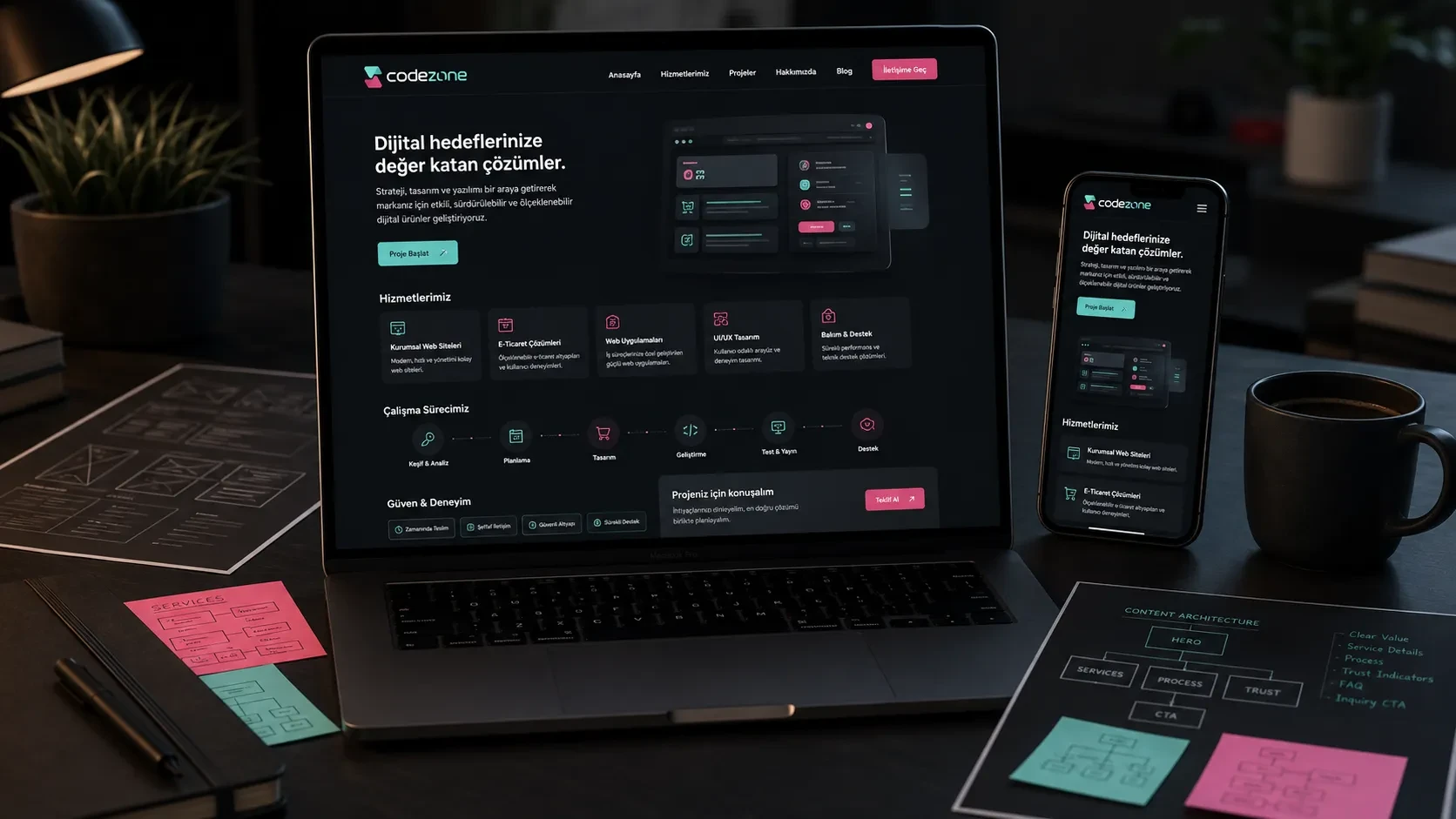
A service-focused corporate website should do more than introduce the company.
Potential customers usually visit with a specific need. They may be researching a service, comparing different providers, trying to understand project scope, or deciding whether they are ready to contact the company.
The website should help them move through that decision process clearly.
Visitors need to understand what the company offers, which service fits their needs, how the working process is structured, what they can expect from the project, and how they can take the next step.
For this reason, a service-focused website should bring positioning, service architecture, content, trust signals, user journeys, forms, SEO, and analytics together.
When these areas work as one system, the website becomes more than a corporate presentation. It becomes an active part of the company’s sales and communication process.
Start With a Clear Service Architecture
The first step is defining the company’s services clearly.
Many companies describe their work using broad categories that may make sense internally but remain difficult for potential customers to interpret.
The service architecture should reflect how customers think about their needs.
For example, a digital product company might organize its services around:
Corporate Websites
E-Commerce
Mobile Applications
Web Applications
Admin Panels
API Integrations
Digital Product Development
Each service should represent a clear area that customers can understand and evaluate independently.
The structure should answer questions such as:
What are the company’s primary services?
Which services deserve their own pages?
Which services belong under a broader category?
Which services are most commercially important?
Which services are commonly searched for?
Which services are often purchased together?
A clear service hierarchy also makes navigation easier.
Visitors can identify the relevant area quickly instead of trying to interpret a long list of capabilities.
The Homepage Should Introduce the Services Without Explaining Everything
The homepage should give visitors an overview of what the company does while directing them toward more detailed service pages.
Trying to explain every service in depth on the homepage can create a long and difficult-to-scan experience.
A stronger structure can include:
Clear hero message
Main service areas
Short positioning statement
Selected projects or references
Working process
Trust signals
Editorial content
Contact or quote CTA
The homepage service section should act as a navigation layer.
Each service can be introduced with:
Service name
Short explanation
Relevant visual
Link to the service page
For example:
Corporate Websites
Corporate websites designed around brand communication, content management, SEO, and performance.
E-Commerce
Commerce experiences connecting product discovery, checkout, payments, shipping, and daily operations.
Mobile Applications
Mobile products planned around user journeys, backend infrastructure, admin management, and post-launch development.
This gives visitors enough context to choose the right direction without overwhelming them with detail.
Each Core Service Should Have Its Own Page
Dedicated service pages are one of the most important parts of a service-focused corporate website.
A potential customer searching for a specific service should be able to land directly on a page focused on that need.
Each service page should explain:
What the service is
Who it is suitable for
Which needs it addresses
What is included in the scope
How the project process works
Which deliverables may be included
Which technical areas are relevant
What happens after launch
How to start a conversation
This creates a stronger decision-making environment than placing all services on one generic page.
Dedicated service pages also create better opportunities for SEO, advertising campaigns, internal linking, and content marketing.
A company can direct visitors from articles, campaigns, social media, or search engines toward the service that most closely matches their intent.
Service Pages Should Begin With the Customer Need
A service page should not begin only by describing the company.
Visitors usually arrive because they are trying to solve a specific need.
The first section should therefore help them recognize whether the service is relevant.
For example, a corporate website service page may speak to companies that:
Need to redesign an outdated website
Want to explain their services more clearly
Need stronger content management
Want to improve SEO and performance
Need a multilingual structure
Want to generate more qualified inquiries
An e-commerce service page might instead focus on:
Product and category architecture
Checkout and payment
Shipping and invoicing
Inventory management
Admin operations
Integrations
Analytics
Starting with real customer needs makes the page easier to understand and helps visitors connect the service with their own situation.
Explain the Scope Clearly
One of the main questions potential customers have is:
What is actually included in this service?
A service-focused website should make project scope easier to understand.
Depending on the service, scope areas may include:
Discovery
Information architecture
UX planning
UI design
Frontend development
Backend development
CMS
Admin panel
Integrations
SEO foundations
Analytics
Testing
Deployment
Post-launch support
The website does not need to turn every service page into a technical specification.
However, visitors should have enough information to understand the overall structure of the engagement.
Clear scope communication also improves the quality of incoming inquiries.
Potential customers who understand the service more accurately can describe their needs more clearly when they contact the company.
Explain the Working Process
Service businesses often sell expertise, planning, communication, and execution rather than a standardized physical product.
The working process therefore becomes an important trust signal.
Visitors may want to understand:
What happens after they contact the company?
How is project scope defined?
When does design begin?
How are revisions handled?
When does development start?
How is testing managed?
What happens before launch?
Is support available afterward?
A project process can be presented through stages such as:
Discovery and Scope
Information Architecture
UX and UI Design
Development
Testing and Content
Launch
Continuous Improvement
The exact stages depend on the type of service.
The purpose is to make the engagement feel understandable and predictable.
When potential customers can visualize how the project will move forward, contacting the company requires less uncertainty.
Use Trust Signals Throughout the Service Journey
Trust should not be limited to one section containing customer logos.
A service-focused website can build confidence through several types of information.
Useful trust signals may include:
Selected projects
Case studies
Customer references
Team expertise
Technologies
Clear project process
Technical explanations
Frequently asked questions
Editorial content
Post-launch support approach
The strongest trust signals are usually connected to the service being evaluated.
For example, someone considering an e-commerce project may find an e-commerce case study more valuable than a general client logo.
Someone evaluating a mobile application project may want to see how backend, publishing, analytics, and ongoing development are handled.
Relevant proof makes each service page more persuasive without relying on exaggerated marketing language.
Use Case Studies to Show the Service in Practice
Case studies help visitors understand how a service translates into a real project.
A useful case study can explain:
Client or project context
Initial need
Project goals
Scope
Solution
Design approach
Technical structure
Key product decisions
Final experience
Where available, measurable outcomes can also be included.
For example:
Increased conversion
Improved performance
Reduced operational workload
Faster content management
Higher customer engagement
When measurable results are not available, the case study can still demonstrate how the team approached the challenge and what was delivered.
The goal is to help potential customers imagine how a similar project could work for their own business.
Editorial Content Should Support Service Pages
Articles and guides can play an important role in a service-focused website.
Potential customers may not begin their journey by searching directly for a service provider.
They may first search for questions such as:
How much does a corporate website cost?
What should an e-commerce checkout include?
Does a mobile app need a backend?
How should an admin panel be planned?
What is API integration?
How should a SaaS product be structured?
Educational content allows the website to meet visitors earlier in the decision process.
Relevant articles can then direct readers toward related service pages.
The service page can also link back to deeper guides for visitors who want more information.
This creates a connected content ecosystem rather than isolated pages.
The relationship can work like this:
Search → Article → Service Page → Case Study → Quote Request
or:
Homepage → Service Page → Related Guide → Contact
This makes editorial content part of both SEO and customer acquisition.
CTA Language Should Match Visitor Intent
Every visitor is not ready to request a quote immediately.
The website should therefore support different levels of intent.
A visitor early in the process may want to:
Explore services
Read an article
Review previous work
Understand the process
A visitor further along may be ready to:
Tell the company about their project
Request a quote
Schedule a meeting
Ask a specific question
CTA language can reflect these stages.
Examples include:
Explore the Service
View Selected Work
Learn About Our Process
Tell Us About Your Project
Request a Quote
Schedule a Meeting
The strongest CTA should generally be connected to the primary business objective.
For project-based service companies, “Tell Us About Your Project” can provide a more natural entry point than simply “Contact Us.”
It creates a clear context for the conversation and helps visitors understand what information the company wants to receive.
Forms Should Collect Useful Project Information
The contact experience should support the sales process rather than simply collect an email address.
A project or quote request form may include:
Full name
Email
Phone number
Company
Service or project type
Budget range
Project details
The number of fields should reflect the company’s sales process.
If the first goal is simply to begin a conversation, a shorter form may be enough.
If the team needs more information to qualify projects, service type, budget, and project details can improve lead quality.
The form should also explain what happens after submission.
For example:
“We’ll review your project and get back to you with a clear next step.”
This gives the visitor a more predictable experience.
SEO Should Be Planned Around Individual Services
Each core service can represent a separate search intent.
For this reason, service pages should have their own SEO structure.
Relevant elements may include:
Dedicated URL
Unique H1
Service-specific content
Meta title
Meta description
Internal links
Image alt text
Structured headings
Related articles
Relevant case studies
A company offering corporate website development and mobile application development should generally not expect one generic “Services” page to perform equally well for both topics.
Dedicated pages give search engines and users clearer context.
Editorial content can then expand the topic further.
For example, a corporate website service page can connect with guides about:
Website planning
Content preparation
CMS selection
SEO
Quote requests
Multilingual websites
Over time, these connections can create stronger topic clusters around the company’s main services.
The CMS Should Support Service-Focused Growth
A service-focused website will usually continue evolving after launch.
New services may be added. Existing service descriptions may change. Case studies, team members, FAQs, and articles will continue to grow.
The CMS should support these updates without requiring development work for routine changes.
Useful content types may include:
Services
Sub-services
Articles
Projects
Case studies
Team members
FAQs
Testimonials
SEO fields
Reusable components can also make service pages easier to maintain.
For example, teams may reuse:
Process sections
CTA blocks
Related article sections
Project cards
FAQ components
Technology blocks
This creates consistency while still allowing each service page to communicate its own story.
The CMS should support the content strategy rather than forcing every page into an identical template.
Mobile Experience Should Support Service Discovery
Potential customers may research services entirely from a mobile device.
The website should make it easy to understand and compare services on smaller screens.
Important areas include:
Simple navigation
Clear service names
Readable headings
Short introduction sections
Comfortable CTA buttons
Fast-loading visuals
Easy forms
Clear page hierarchy
Long service pages should also remain easy to scan.
Sections, headings, cards, and appropriate spacing can help visitors understand the content without reading every paragraph from beginning to end.
Mobile performance is equally important.
A service website with heavy images or unnecessary scripts may create friction before visitors even reach the information they need.
Speed and usability should therefore be treated as part of the service presentation itself.
Measure Which Services Generate Real Interest
A service-focused website should be measurable after launch.
Traffic alone does not show whether visitors are finding the right services or moving toward contact.
Useful metrics may include:
Service page views
Organic traffic by service
CTA clicks
Quote request submissions
Form completion rate
Blog-to-service transitions
Service-to-contact transitions
Case study views
Mobile and desktop behavior
Lead source
This helps the company understand which service areas generate stronger interest.
For example, one service page may receive significant traffic but very few inquiries.
That could indicate that its positioning, content, proof, or CTA needs improvement.
Another page may receive less traffic but generate highly qualified requests.
That could become an important area for additional SEO or campaign investment.
Measurement makes it possible to improve the website based on actual customer behavior.
Codezone’s Approach
At Codezone, we plan service-focused corporate websites around the relationship between the brand, services, visitor intent, content, user journeys, and lead generation.
We begin by defining the company’s primary services, target audiences, customer questions, and the actions visitors should take.
From there, we structure the homepage, individual service pages, content architecture, case studies, CMS, SEO, CTAs, and measurement around the same system.
This approach turns the website into a digital platform where visitors can understand services clearly, build confidence in the company, explore relevant expertise, and move toward the right contact step.
Conclusion
A service-focused corporate website should make the company’s expertise easy to understand and its services easy to evaluate.
Clear service architecture, dedicated service pages, customer-focused content, project process explanations, relevant trust signals, case studies, editorial content, CTAs, forms, SEO, and analytics should all support the same visitor journey.
The goal is not simply to display a list of services.
The website should help potential customers understand which service fits their needs, what working with the company will involve, and how to begin the conversation.
When structured correctly, a service-focused corporate website becomes an important part of both brand communication and customer acquisition.
Frequently Asked Questions
What is a service-focused corporate website?
A service-focused corporate website is structured around helping visitors understand, evaluate, and enquire about the company’s services. Service pages, case studies, content, CTAs, and contact flows are organized around the customer decision process.
Should every service have its own page?
Core services generally benefit from dedicated pages. This creates clearer communication for visitors and provides stronger foundations for SEO, campaigns, internal linking, and lead generation.
What should a service page include?
A service page can explain who the service is for, what needs it addresses, project scope, process, deliverables, relevant work, frequently asked questions, and the next step for contacting the company.
How can a service-focused website generate more customer inquiries?
Clear positioning, dedicated service pages, relevant trust signals, useful content, strategically placed CTAs, simple forms, and conversion tracking can help visitors move naturally toward contacting the company.
Why are articles important on a service-focused website?
Articles can answer customer questions earlier in the decision process, support organic search visibility, demonstrate expertise, and guide visitors toward relevant service pages.