
How Should Campaigns, Coupons, and Discounts Be Structured on an E-Commerce Website?

E-commerce campaigns, coupons, and discounts should be planned together with product structure, customer groups, cart rules, inventory, admin management, and analytics.
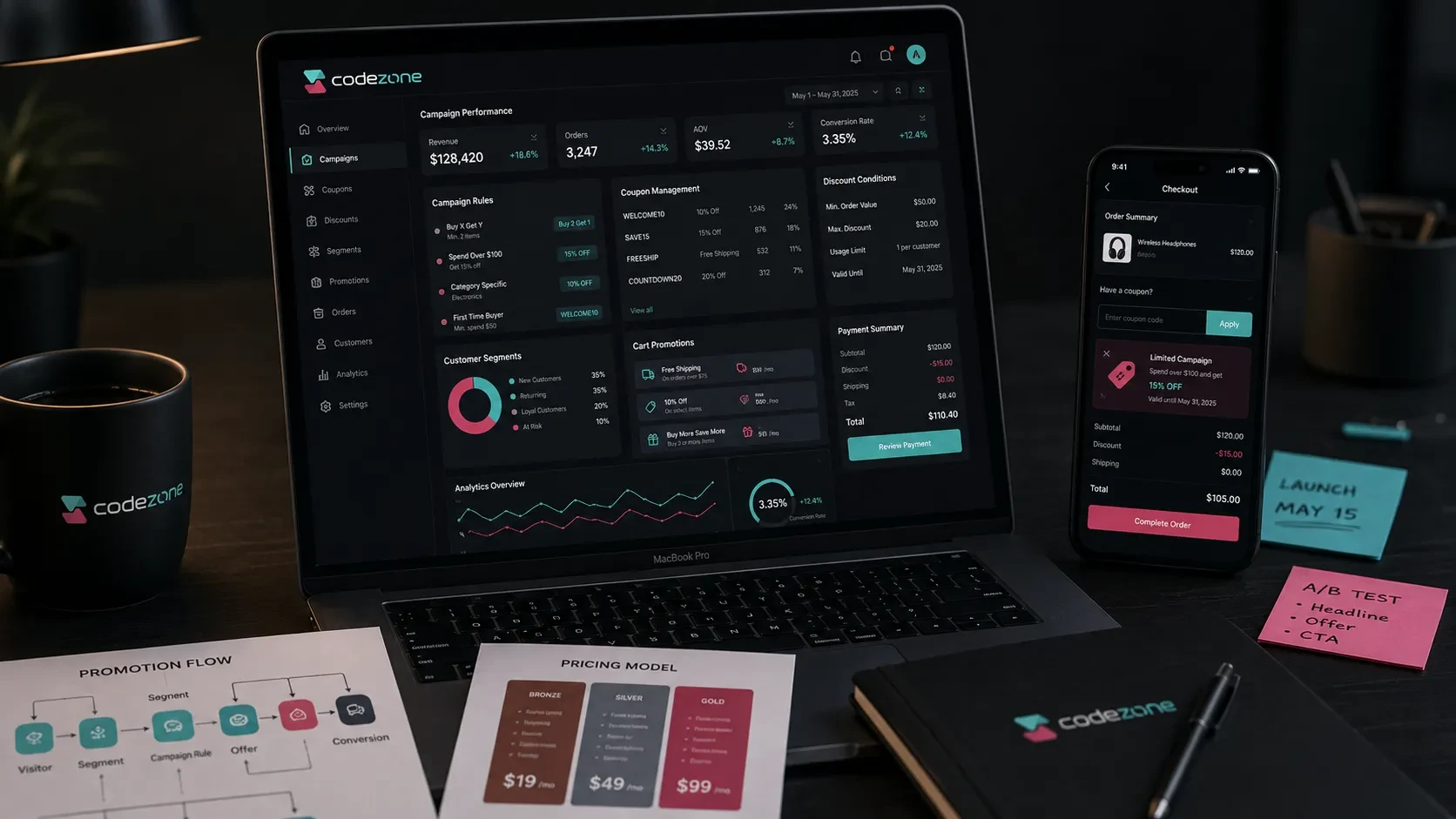
Campaigns, coupons, and discounts are important parts of an e-commerce sales strategy.
They can encourage first purchases, support seasonal sales, increase average order value, promote specific products, reward existing customers, and create more targeted offers for different customer groups.
However, a campaign system involves more than simply reducing a product price.
The platform needs to understand which products the campaign applies to, which customers can use it, when it starts and ends, whether it can be combined with other offers, how many times it can be used, and how the discount should be reflected in the cart.
For this reason, campaign logic should be planned together with product data, customer accounts, checkout, inventory, the admin panel, and reporting.
When these rules are clearly defined, marketing teams can manage campaigns more easily while customers receive a more predictable shopping experience.
Different Campaign Types Should Be Defined
Not every campaign needs to work in the same way.
The first step is defining which promotion models the business actually needs.
Common campaign types may include:
Product-based discounts
Category-based discounts
Brand-based discounts
Percentage discounts
Fixed-amount discounts
Coupon codes
Minimum cart value discounts
Free shipping
First-order discounts
Customer-specific offers
User-group campaigns
Buy X, Get Y campaigns
Quantity-based discounts
Bundle offers
Automatic cart discounts
Seasonal campaigns
Each campaign type introduces different business rules.
For example, a percentage discount on one product is relatively simple.
A campaign such as “Buy three products from this category and receive 20% off the lowest-priced item” requires more detailed cart logic.
The campaign infrastructure should therefore be designed around realistic sales scenarios rather than adding rules one by one after launch.
Product and Category Rules Should Be Clear
A campaign may apply to the entire catalog or only to selected products.
The system should clearly define where a promotion is valid.
Possible targeting rules include:
All products
Selected products
Selected categories
Selected brands
Specific variants
Products above or below a certain price
New products
Clearance products
Campaign collections
Exclusion rules can be equally important.
For example, a general coupon may apply across the website while excluding:
Already discounted products
Specific brands
Newly launched products
Gift cards
Certain product categories
These relationships should be manageable through structured product and category data.
If the catalog is not organized consistently, creating and maintaining campaigns becomes significantly more difficult.
Campaign Start and End Dates Should Be Managed Automatically
Time-based campaigns should have clearly defined start and end dates.
The system may allow teams to configure:
Campaign start date
Campaign start time
Campaign end date
Campaign end time
Time zone
Scheduled activation
Scheduled expiration
Once configured, the campaign should become active and inactive automatically.
This is particularly useful for:
Seasonal sales
Weekend campaigns
Black Friday offers
Holiday promotions
Limited-time product launches
Flash sales
Marketing teams should not need to manually activate or deactivate every campaign at the exact required time.
Scheduled rules create a more predictable campaign operation and reduce the risk of discounts remaining active longer than intended.
Coupon Codes Need Usage Rules
Coupon codes allow a promotion to be distributed to a specific customer group, marketing channel, or campaign audience.
Examples may include:
WELCOME10
SUMMER20
NEWCUSTOMER
FREESHIPPING
The code itself is only one part of the system.
The platform also needs to understand the rules behind it.
A coupon may include:
Percentage discount
Fixed discount amount
Minimum cart value
Maximum discount amount
Eligible products
Eligible categories
Customer eligibility
Start and end dates
Total usage limit
Usage limit per customer
First-order requirement
Minimum product quantity
For example, a coupon might provide 15% off orders over a defined cart value, with a maximum discount limit and one use per customer.
These rules should be clearly visible to both the system and the internal team managing the campaign.
Customer Groups Can Support More Targeted Campaigns
Not every promotion needs to be available to every visitor.
Customer groups can be used to create more relevant offers.
Possible segments include:
New customers
Existing customers
Members
Non-members
VIP customers
Dealers
Corporate customers
Customers who have not purchased recently
Customers with a specific purchase history
Users from a campaign-specific audience
For example, first-time customers may receive a welcome discount.
Existing customers may receive a campaign based on their previous purchases.
B2B customers may receive discounts according to dealer level or commercial agreement.
This structure allows campaigns to become more closely aligned with customer relationships rather than functioning only as public price reductions.
Minimum Cart Value and Quantity Rules Should Be Planned
Many campaigns depend on cart conditions.
Examples include:
10% off orders over TRY 2,000
Free shipping over TRY 1,500
Buy three products and receive a discount
Buy two items from the same category and receive 15% off
The system should determine exactly when the condition is met.
Important questions include:
Is the minimum amount calculated before or after other discounts?
Does shipping count toward the minimum amount?
Are all products included?
What happens if the customer removes an item afterward?
Are returned items included when recalculating the campaign?
These details directly affect cart totals and customer expectations.
Campaign calculations should therefore be part of the checkout logic rather than handled as an isolated promotional layer.
Campaign Combination Rules Should Be Defined
One of the most important parts of discount architecture is deciding whether multiple promotions can be used together.
For example, can a customer use:
A discounted product and a coupon at the same time?
A category campaign together with free shipping?
Two different coupon codes?
A customer-specific discount together with a public promotion?
Possible approaches include:
Only one promotion per order
One coupon plus automatic campaigns
Multiple compatible campaigns
Best available discount automatically selected
Campaign priority rules
Without clear rules, customers may encounter unexpected totals while the business may provide discounts that were never intended to be combined.
Campaign priority can help resolve these scenarios.
For example:
Customer-specific price
Product campaign
Cart discount
Coupon
Shipping campaign
The exact structure depends on the business model.
What matters is that the calculation order is predictable and testable.
Discounts Should Be Clearly Visible in the Cart
Customers should be able to understand which campaign has been applied and how the final total was calculated.
The cart may display:
Original product price
Discounted price
Applied campaign
Coupon code
Discount amount
Shipping discount
Cart subtotal
Final total
The discount should not appear only as a changed final price with no explanation.
Clear presentation strengthens trust and makes the value of the campaign easier to understand.
Coupon fields should also be positioned carefully.
If the field is overly prominent, users without a coupon may leave the checkout to search for one.
A balanced approach is to keep it visible but secondary, such as within an expandable area in the cart summary.
When a coupon is applied successfully, the system should show a clear confirmation.
If it cannot be used, the error message should explain the reason in simple language.
Campaigns Should Work Together With Inventory
Promotions can create sudden demand for specific products.
For this reason, campaign planning should also consider inventory.
Important scenarios include:
Limited-stock campaign products
Out-of-stock items within a campaign
Campaign bundles
Variant-level availability
Product limits per customer
Flash-sale stock
Pre-order campaigns
For example, if a campaign applies to a product that becomes unavailable, the website should reflect that status correctly.
If a promotion is designed around a bundle, the availability of each component may need to be considered before the bundle can be purchased.
High-demand campaigns may also require additional technical planning to prevent multiple users from purchasing the same final unit simultaneously.
Marketing and inventory operations should therefore be connected rather than planned independently.
Free Shipping Should Be Managed as a Campaign Rule
Free shipping is one of the most common e-commerce promotions.
It can be based on conditions such as:
Minimum cart value
Specific products
Specific categories
Customer group
Coupon code
Delivery region
Campaign period
For example:
Free shipping on orders over TRY 1,500
or:
Free shipping for selected products this weekend
The cart should clearly communicate progress toward the threshold.
For example:
“You’re TRY 250 away from free shipping.”
This can help customers understand the offer and may encourage them to add another relevant product to their cart.
Once the threshold is reached, the interface should clearly confirm that free shipping has been applied.
Campaign Management Should Be Easy in the Admin Panel
Marketing teams should be able to create and manage routine campaigns without requiring development support.
A campaign management module may include:
Campaign name
Campaign type
Discount value
Eligible products
Eligible categories
Customer groups
Coupon code
Minimum cart amount
Usage limits
Start and end dates
Combination rules
Campaign status
Reporting
The panel should also allow teams to:
Duplicate existing campaigns
Activate or deactivate campaigns
Schedule campaigns
Review expired campaigns
Search and filter promotions
See usage numbers
Permissions may also be useful.
For example, a marketing user may create a campaign while a manager needs to approve it before publication.
This becomes especially valuable for businesses running frequent promotions.
Important Campaign Scenarios Should Be Tested Before Launch
Campaign systems can quickly become complex when several rules interact.
Testing should therefore cover more than a single successful coupon scenario.
Useful tests may include:
Valid coupon
Invalid coupon
Expired coupon
Coupon before campaign start
Minimum cart amount not reached
Minimum cart amount reached
Usage limit exceeded
Customer has already used the coupon
Discounted product excluded from coupon
Multiple campaigns active simultaneously
Product removed after discount is applied
Partial return of a discounted order
Complete return
Free-shipping threshold
Customer-specific campaign
Mobile checkout
Different payment methods
Testing becomes particularly important when promotion logic affects payments, invoicing, refunds, or reporting.
The total calculated by the storefront, payment provider, order system, and invoice system should remain consistent.
Campaign Performance Should Be Measured
Campaigns should be evaluated after launch using real sales data.
Useful metrics may include:
Campaign views
Coupon usage
Orders using a campaign
Campaign conversion rate
Revenue generated
Average order value
Discount amount
New customers acquired
Repeat customers
Free-shipping usage
Product performance during the campaign
Category performance
Campaign profitability
A high coupon usage rate alone does not necessarily mean the campaign was successful.
The team should also understand:
Did the campaign increase order value?
Did it generate new customers?
Did customers purchase again afterward?
Did the discount reduce margin too heavily?
Which products performed best?
Did the campaign create inventory issues?
These insights can improve future promotional planning.
Over time, campaigns can be shaped around actual customer behavior instead of relying only on broad discount strategies.
Codezone’s Approach
At Codezone, we plan campaign, coupon, and discount structures as part of the complete e-commerce architecture.
We evaluate product data, categories, customer groups, cart rules, pricing, inventory, payment flows, the admin panel, and analytics together.
This allows marketing teams to create and manage promotions through a clear operational structure while customers receive consistent pricing and campaign information throughout the shopping journey.
The goal is to create a promotion system that can support current sales strategies and remain flexible enough for new campaign models as the e-commerce operation grows.
Conclusion
Campaigns, coupons, and discounts should be planned as part of the overall e-commerce system rather than as isolated price changes.
Product eligibility, categories, customer groups, cart conditions, usage limits, campaign dates, combination rules, inventory, free shipping, admin management, and reporting all influence how a promotion works.
When these rules are clearly defined, customers can understand the value of the campaign more easily and complete their purchase with greater confidence.
Internal teams also gain a more manageable structure for creating, scheduling, monitoring, and improving promotions over time.
Frequently Asked Questions
Which campaign types can be used on an e-commerce website?
Product discounts, category discounts, coupon codes, minimum cart value offers, free shipping, first-order discounts, customer-specific campaigns, quantity discounts, bundle offers, and automatic cart discounts can all be used depending on the sales strategy.
How should coupon usage limits be defined?
Coupons can have a total usage limit, a per-customer limit, start and end dates, minimum cart value, customer eligibility, and product or category restrictions.
Can multiple discounts be used in the same order?
Yes, if the campaign architecture allows it. The business should define which promotions can be combined and in what order different discounts are calculated.
Should campaigns be managed through the admin panel?
Yes. Marketing teams should ideally be able to create campaigns, select products or categories, define dates and customer groups, configure limits, and review campaign performance from the admin panel.
Which campaign metrics should be tracked?
Coupon usage, campaign orders, conversion rate, revenue, average order value, discount amount, new customer acquisition, repeat purchases, product performance, and campaign profitability can all provide useful insights.