
Ready E-Commerce Infrastructure or Custom Software?

Explore the differences between ready e-commerce infrastructure and custom software. Determine the right e-commerce solution based on product structure, integrations, operations, cost, and growth goals.
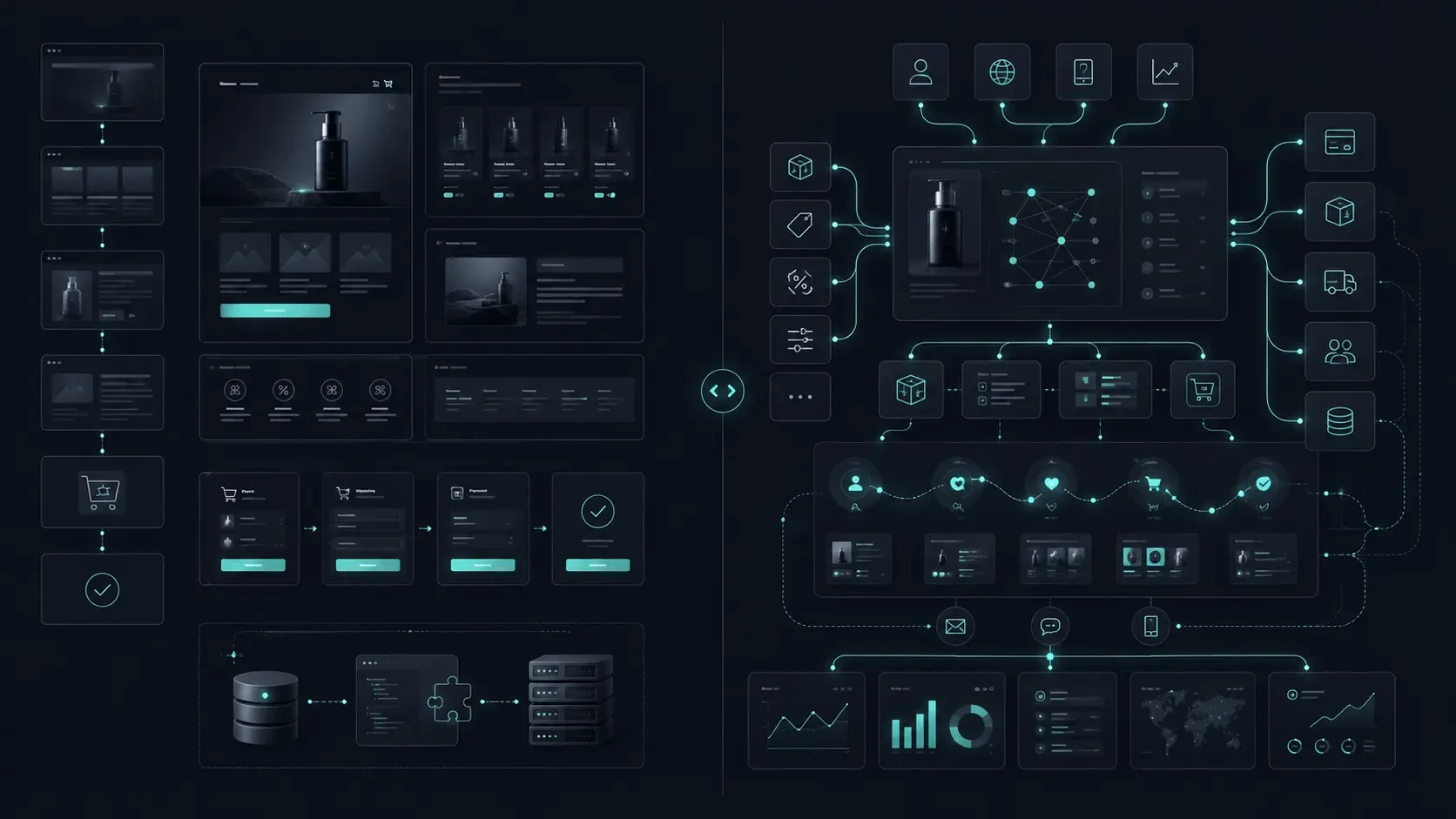
Ready e-commerce infrastructures and custom software solutions cater to different business needs. The right choice should be made by evaluating product structure, sales model, integrations, operational processes, and long-term growth plan together.
Businesses planning an e-commerce project face an important decision early on:
Should they proceed with a ready e-commerce infrastructure or develop a custom system tailored to the business's needs?
This decision not only determines how the website will look.
It also directly affects how products will be managed, what purchasing experience customers will have, the daily operations of the team, integrations, and future development areas.
Ready infrastructures can offer a quick and practical start for standard sales processes. Custom software, on the other hand, can provide a more flexible foundation when product structure, operational model, or customer experience goes beyond standard flows.
The aim here is not to show one approach as superior to the other.
The right choice is to determine the structure that supports the experience your business needs today and aligns with your growth goals.
In this article, we will discuss the differences between ready e-commerce infrastructures and custom software in terms of product structure, operations, integrations, cost, and long-term development.
What is the Difference Between Ready E-Commerce Infrastructure and Custom Software?
Ready e-commerce infrastructures offer the basic sales features needed by many businesses in a ready-to-use manner.
Areas such as adding products, creating categories, cart, payment, order management, campaign definition, and basic shipping processes are usually included in the system's standard structure.
This approach progresses through certain rules and ready modules.
Custom e-commerce software, on the other hand, is developed by considering the business's sales model, product structure, customer experience, and operational processes.
The aim here is not to develop every area from scratch. The aim is to design the flows and management experience that the business truly needs in the right way.
The main difference can be summarized as follows:
Ready infrastructure offers a quick start to standard sales processes.
Custom software creates a more flexible structure shaped according to the brand and business model.
Both approaches can be valuable in the right scenario.
When making a decision, the number of products, sales channels, integration needs, team structure, and growth plan of the business should be evaluated together.
Which Businesses are Suitable for Ready E-Commerce Infrastructure?
Ready infrastructures can be a strong starting point for businesses that want to quickly respond to basic e-commerce needs.
It offers a practical solution especially for brands with a simple product structure, progressing with standard payment and shipping processes, and wanting to start selling in a short time.
Ready e-commerce infrastructure may be suitable for businesses with the following needs:
Limited or medium-sized product catalog
Standard product variations
Single end-user sales model
Basic discount and coupon scenarios
Standard payment methods
Simple shipping integrations
Goal to go live in a short time
Businesses starting digital sales for the first time
Structures where the operational process is not yet complex
The advantage of ready infrastructure is that it allows focusing earlier on product, content, campaign, and sales strategy by spending less time on the technical foundation.
The management panels offered by these structures can provide many areas needed for daily operations in a ready manner.
A successful ready infrastructure project can turn into a strong experience with the right theme selection, design adjustments suitable for the brand, content quality, structure of product pages, and careful planning of the purchasing flow.
Which Businesses are Suitable for Custom E-Commerce Software?
Custom e-commerce software gains value in projects where the sales model or operation requires a more unique structure.
For some businesses, the standard product, cart, and payment flow may be sufficient. In some businesses, however, the presentation of products, pricing rules, user permissions, order process, or system integrations require more detailed planning.
Custom development can become more meaningful in the following cases:
Dealer or B2B sales model
User-specific pricing
Different product and catalog structures for different customer groups
Complex product configurations
Multiple warehouses or stock sources
Special offer and approval processes
Subscription or membership-based sales model
Intensive data flow with ERP, CRM, or warehouse software
Managing marketplace, physical store, and e-commerce channel together
Brand-specific payment or delivery scenarios
High traffic expectation
Special campaign and loyalty setups
Custom software does not mean adding every feature the business needs from day one.
A healthy approach is to determine the most valuable flows in the first version, implement them with a reliable infrastructure, and add new needs in a planned manner as the product develops.
Product Structure and Catalog Complexity
When choosing an e-commerce infrastructure, it is not enough to only look at the number of products.
What is more important is how the products are structured and what information the customer needs to see about the product.
For example, if a single product only has a name, price, and a few images, product management can be simpler.
However, when products include different sizes, colors, measurements, technical features, packages, customization options, or stock rules, the catalog structure becomes more comprehensive.
The following needs can directly affect the product management structure:
Multiple variations
Package or set products
Customizable products
Subscription products
Digital products
Pre-order flows
Product comparison need
Complementary product recommendations
Different warehouse or supplier stocks
Multiple currencies
Product visibility according to different countries
Ready infrastructures can meet many standard product scenarios.
However, when the catalog structure becomes central to the business model, custom data models and flexible management experience can become more valuable.
The earlier the product structure is planned, the smoother both the customer's product discovery experience and the team's daily management will progress.
B2B Sales, Custom Pricing, and User Roles
B2B e-commerce creates different needs compared to the standard store experience that sells directly to the end-user.
Some customers can only see the products assigned to them. For some, different price lists, minimum order amounts, payment terms, or offer approval flows may be required.
In such structures, user roles and permissions are at the center of the e-commerce experience.
For example, the following user groups may exist in the system:
End user
Dealer
Corporate customer
Purchasing authority
Sales representative
Operations team
Manager
The products, prices, stock information, and order permissions that each user can see may differ.
In projects with special pricing or dealer processes, the following areas also gain importance:
Catalogs specific to the user or group
Tiered discount structures
Minimum order rules
Offer creation and approval flows
Deferred payment options
User-based order history
Sales representative assignment
Corporate account management
Reporting by authority
Proper planning of these structures transforms the e-commerce experience from just a sales channel into a system that supports the business's commercial operations.
Integrations and Operational Processes
The customer-side experience of an e-commerce site is not independent of the operational systems in the background.
With the receipt of the order, stock, invoice, shipping, customer notification, return, and reporting processes come into play.
Therefore, integrations should be considered as a natural part of product planning, not as technical details added at the end of the project.
Common integration areas are as follows:
Payment systems
Shipping companies
E-invoice and pre-accounting software
ERP systems
CRM platforms
Warehouse and stock management tools
Marketplaces
Email and marketing automation
Customer support systems
Loyalty and membership platforms
Analytics and reporting tools
Here, not only which systems will be connected but also how the data will move should be clarified.
For example, from which system will the stock information come? Where will the order information be transferred? What process will run when incorrect pricing or missing stock data occurs? In which system will the return information be updated?
The answers to these questions directly affect the infrastructure choice.
Ready e-commerce systems can offer suitable solutions for many common integrations. More specific data flows and operational needs may require a flexible software architecture.
Customer Experience and Brand Control
Design on an e-commerce site is not just a visual issue.
The way products are discovered, category structure, filters, product pages, campaign areas, cart experience, and payment flow are part of the customer's relationship with the brand.
Ready infrastructures can provide flexibility that can create a sufficient user experience for most brands.
Conversely, if the purchasing journey is at the center of the brand's competitive advantage, custom user flows may gain more significance.
For example, a brand-specific experience need may arise in the following areas:
Homepage changing according to different customer types
Custom product discovery flows
Configurator or product builder tools
Personalized recommendations
Complex campaign scenarios
Special delivery or scheduled delivery structures
Membership-based shopping experience
Purchase model progressing with request for proposal
Loyalty and repeat purchase flows
Custom development does not mean that the brand needs to differentiate every area.
The strongest user experience is the one that facilitates the customer's decision and ensures the sustainable progress of the operation.
Initial Cost and Long-Term Cost
When choosing an e-commerce infrastructure, cost should not be evaluated only based on the initial development budget.
Ready infrastructures can provide a more controlled cost and shorter time to go live initially. Custom software, on the other hand, may require a broader planning and development process at the first stage.
In long-term evaluation, the following areas gain importance:
New feature addition process
License, application, or plugin costs
Maintenance needs of integrations
Daily workload of the operations team
Performance and traffic needs
Content and campaign management
Improvement areas in user experience
Adaptation to new sales channels
Technical maintenance and security updates
The right choice is not to find the lowest initial cost.
The right choice is to establish a structure that supports the business's sales model, allows the team to work comfortably, and aligns with growth goals.
In some projects, ready infrastructure can be used healthily for years. In some projects, however, custom development can start to produce value earlier in terms of operational efficiency and customer experience.
Questions to Ask Before Making a Decision
When deciding between ready infrastructure or custom software, it is necessary to clarify the business model before the technology list.
The following questions can make the decision process healthier:
How many products and product variations will be managed?
How will the product catalog grow in the next two years?
Will sales be made to the end-user, dealers, or both?
Is special pricing or product visibility required for customer groups?
Are there ERP, CRM, warehouse, accounting, or marketplace integrations?
How are order, invoice, shipping, and return processes managed today?
Which areas does the operations team want to manage without technical support?
Are there special rules in payment and delivery processes?
Does a brand-specific purchasing experience provide a competitive advantage?
Which features are really necessary in the first version?
How easily should the system be able to develop when new needs arise?
What is the targeted publication date and investment plan?
The answers to these questions determine not only the technical infrastructure but also the scope of the first version and the long-term roadmap of the product.
Codezone's E-Commerce Approach
At Codezone, we plan the e-commerce infrastructure together with the brand's sales strategy and operational structure.
In every project, we evaluate the product catalog, customer segments, purchasing journey, daily management needs of the teams, and connections to be established with existing systems.
This evaluation shapes the right infrastructure approach, product and category structure, user roles, integration plan, and management experience.
We consider the value offered by ready infrastructures for quick start and standard sales processes together with the opportunities provided by custom software for flexibility, special workflows, and growth goals.
As Codezone, the aim is to create a sustainable e-commerce experience where customers shop comfortably, teams manage with confidence, and the business adapts to growth.
Conclusion
Choosing between ready e-commerce infrastructure and custom software is not just a technical decision.
This decision affects how products will be managed, the purchasing experience of customers, the working style of the operations team, integrations, and long-term development capacity.
Ready infrastructures can offer a quick and strong start for businesses with standard needs.
Custom software, on the other hand, can provide a more flexible foundation for businesses with more unique sales models, product structures, or operational flows.
The most accurate decision is the structure that supports your business's current needs, the customer experience it aims for, and its future growth plan together.
Frequently Asked Questions
Is it reasonable to start selling with a ready e-commerce infrastructure?
Yes. Ready infrastructures can be a strong start for businesses with standard sales flows, simple product structures, and the goal of going live in a short time. An effective sales experience can be created with the right theme, content, product structure, and operation plan.
At what point does custom e-commerce software become necessary?
Dealer system, user-specific pricing, complex product structure, ERP or CRM integrations, multi-warehouse management, special purchasing flows, and advanced operational needs can make custom software more meaningful.
Can you start with ready infrastructure and switch to custom software later?
Yes. As the business's needs grow, a transition to a more flexible structure can be planned. In this process, the transfer of product, customer, order, content, and SEO data should be handled carefully.
Does a custom software e-commerce project take longer?
Custom development can be a more comprehensive process as it requires needs analysis, user experience, technical architecture, and integration planning. The duration is determined by the scope of the project's first version and the complexity of the workflows.
How should I compare the cost of ready infrastructure and custom software?
In addition to the initial investment, license, plugin, integration, maintenance, operation, performance, and new feature development costs should be evaluated together. A healthy comparison should be made not only based on the initial offer amount but also on the long-term value the system will provide to your business.