
How Should a Multilingual Corporate Website Be Structured?

A multilingual corporate website should be planned around target markets, content localization, SEO, CMS, user experience, forms, and long-term content management rather than translation alone.
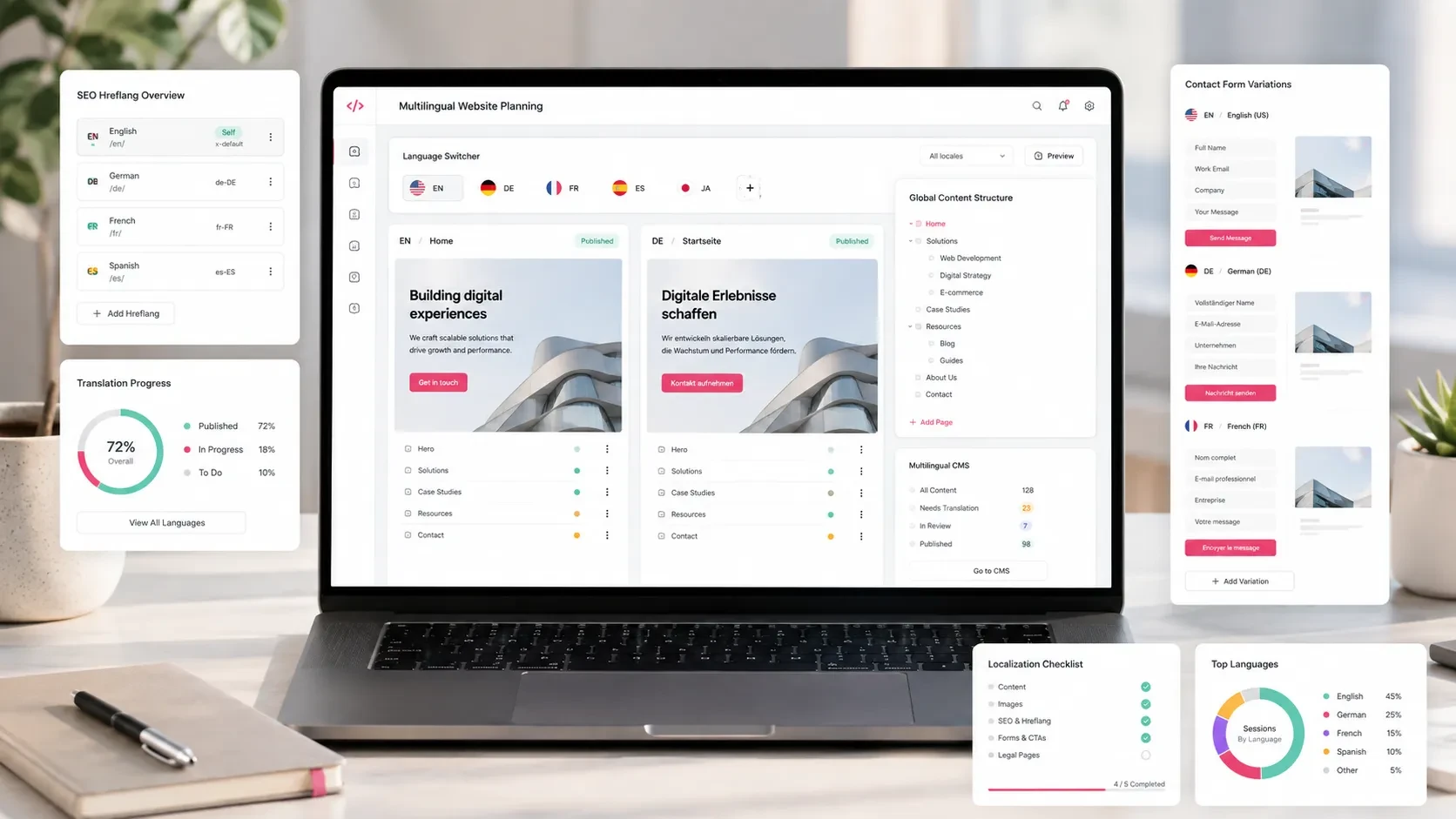
A multilingual corporate website is an important digital foundation for companies that want to reach customers, partners, or users across different countries and markets.
If a company exports its products, works with international customers, communicates with global partners, or plans to expand into new regions, the language structure of its website should be considered from the beginning of the project.
A multilingual website involves much more than translating existing text.
Language selection, URL architecture, content management, SEO, forms, contact information, visual content, analytics, and the CMS should all work together.
When this structure is planned carefully, each visitor can experience the website in a language and context that feels relevant to them. Services, products, references, and communication flows can then support the expectations of each target market more effectively.
Define Target Markets and Languages First
The first step in multilingual website planning is deciding which languages the business genuinely needs.
The same language structure will not be suitable for every company.
Language priorities should reflect target countries, customer profiles, sales channels, and future growth plans.
Useful questions include:
Which countries does the company currently serve?
Which markets does it want to generate new inquiries from?
Which languages directly support the sales process?
Which languages are important for brand positioning?
Will every language contain the same pages and content?
Would a smaller website be sufficient for certain markets?
Is the language structure expected to expand later?
For example, Turkish and English may provide a suitable starting point for an export-oriented manufacturer.
A company focused strongly on European markets may also require German or French.
A healthcare brand working with international patients may prioritize English, Arabic, or Russian depending on its audience.
Defining these priorities early makes both content production and technical planning easier to manage.
Plan Language Structure Together With the URLs
URL architecture is an important part of both user experience and multilingual SEO.
Each language version should have a clear and consistent URL structure.
A common approach is to use language folders:
/tr/en/de/fr
For example:
/tr/hizmetler/en/services/de/leistungen
Another possible approach is to use subdomains such as:
tr.example.comen.example.com
For many corporate websites, a folder-based structure provides a simple and manageable solution because all language versions remain under the same primary domain.
The architecture should also consider future expansion.
Even if the first release includes only two languages, the website may later need a third or fourth language.
Language codes, page slugs, canonical settings, hreflang relationships, and sitemap structure should therefore be defined before development is complete.
Treat Translation and Localization as Different Requirements
A strong multilingual experience requires more than replacing words with their equivalents in another language.
Content should also be localized for the target audience.
Localization means adapting communication to the language, expectations, habits, and decision-making context of a particular market.
The same service may need to be presented differently across countries.
For example, Turkish content may benefit from a more explanatory approach, while English content may work better with shorter and more direct messaging.
In another market, certifications, delivery capabilities, references, or process information may need to appear more prominently.
Localization can affect:
Headlines
Service descriptions
CTA copy
Form explanations
Case studies and references
Currency
Date formats
Contact information
Legal content
Frequently asked questions
This allows each language version to feel like a natural website experience rather than a translated copy of another version.
Build the Multilingual SEO Structure Correctly
SEO for a multilingual corporate website should be planned independently for each language.
Every language version should have its own content, search intent, URLs, titles, and descriptions.
Important multilingual SEO areas include:
Language-specific URLs
Separate meta titles for each language
Separate meta descriptions
Hreflang tags
Language-specific sitemap structure
Canonical configuration
Localized page slugs
Translated image alt text
Correct internal linking
Language switchers that point to equivalent pages
A Turkish search such as “kurumsal web sitesi” and an English search such as “corporate website development” may represent a similar business need, but the actual search behavior and terminology differ between languages.
For this reason, English SEO content should be researched and written for English-speaking users rather than created solely by translating Turkish keywords.
Hreflang is also particularly important.
It helps search engines understand the relationship between different language versions and can help direct users toward the page most relevant to their language or region.
For a more detailed look at the technical foundations, you can read our guide on how to develop an SEO-friendly corporate website.
The CMS Should Support Multilingual Content Management
Content management becomes especially important as the number of languages increases.
The internal team should be able to manage each language without requiring development support for everyday updates.
A multilingual CMS may include:
Language-specific page management
Multilingual blog management
Meta title and meta description fields
Language-specific slug management
Translation status tracking
Missing translation warnings
Shared media management
Language-specific navigation
Language-specific footer content
Multilingual form content
The relationship between different language versions should also be clear to editors.
For example, when the Turkish version of a service page is updated, the CMS can make it visible that the English version may also need revision.
This becomes increasingly valuable as the site grows.
Without a structured workflow, one language can quickly become more up to date than another.
The CMS architecture should therefore consider page relationships, translation status, content ownership, and editorial workflows from the beginning.
For a deeper look at CMS planning, you can read our guide on how to choose a CMS for a corporate website.
Make Language Switching Easy to Use
Users should be able to find the language selector without effort.
It is commonly placed in the header, mobile navigation, or footer.
A good language-switching experience should consider:
Clear visibility
Easy mobile use
Direct navigation to the equivalent page
Understandable language labels
Clear indication of the active language
A simple interaction model
Minimal interruption to the user journey
One of the most important details is page equivalence.
If a visitor is reading a Turkish service page and switches to English, they should ideally reach the English version of that same service.
Sending them back to the homepage forces them to restart their journey and creates unnecessary friction.
For websites with two languages, a simple “TR / EN” structure may work well.
Websites with more languages may benefit from a compact dropdown or dedicated language menu.
Flags should be used carefully because a language does not always correspond to a single country.
Language names or language codes are often clearer.
Adapt Forms and Communication Flows by Language
Forms are part of the multilingual experience too.
If someone is browsing the English version of the website, the form labels, validation messages, confirmation screen, and automated emails should also appear in English.
Areas that may need language-specific versions include:
Form heading
Supporting description
Field labels
Placeholder text
Validation messages
Success message
Automated email content
Privacy information
Contact routing
The language of the submission can also be included in the data sent to internal teams.
For example, a proposal request submitted from the English website might reach the team with information such as:
language: en
This allows the sales or customer relations team to understand immediately which language should be used when responding.
Companies operating across several markets may also need different routing rules.
English inquiries could go to one team, while German requests could be assigned to a specific employee or regional sales group.
The form should therefore be considered part of both the website experience and the internal lead-management process.
For a more detailed look at form planning, you can read our guide on how to structure a quote request form on a corporate website.
Localize Contact and Trust Information Where Necessary
Not every part of a multilingual website needs to remain identical across markets.
Depending on the company structure, different countries may require different contact information, addresses, phone numbers, certifications, references, legal information, or sales representatives.
For example, an international business may have:
A central headquarters
Regional offices
Different sales teams
Market-specific distributors
Different support channels
The relevant information can be shown according to language or market when appropriate.
Trust signals may also vary.
A certification that is particularly important in one market may deserve greater visibility there.
Similarly, local references or market-specific case studies can make the website more relevant to visitors from that region.
Localization should therefore include the commercial context of each market, not only the written copy.
Decide Which Content Should Exist in Every Language
A multilingual website does not necessarily require every piece of content to be available in every language.
Core pages will usually need complete translations.
These may include:
Homepage
About
Main service pages
Product pages
Contact
Key case studies
Privacy and legal pages
Editorial content can be managed more selectively.
For example, an article written around a topic specific to the Turkish market may not provide the same value to an international audience.
Likewise, an English article aimed at global buyers may not need a Turkish equivalent.
The content strategy should define:
Which pages are mandatory in every language
Which blog posts will be translated
Which content will be created specifically for one market
Who approves each language
How outdated translations will be identified
This prevents multilingual content management from becoming an automatic duplication process.
Each language can instead develop into an editorial structure that supports its own audience.
Plan Analytics by Language and Market
Multilingual websites should also be measured by language.
Total website traffic alone does not reveal which markets are creating meaningful business opportunities.
Useful measurements may include:
Traffic by language
Traffic by country
Service page performance by language
Form submissions by language
Conversion rates
Organic search performance
Most visited content
Lead source
Market-specific campaign performance
These insights can influence future content and growth decisions.
For example, the company may discover that English traffic is increasing but generates relatively few inquiries.
That may indicate an opportunity to improve English service pages, forms, trust signals, or targeting.
Another language might produce fewer visitors but a much higher conversion rate.
In that case, expanding the content available in that language may become a meaningful growth opportunity.
Plan the Post-Launch Translation Workflow
Multilingual websites require more structured content maintenance after launch than single-language websites.
Whenever a service page changes, the relevant translations may need to be updated.
When a new campaign, article, project, or product is published, the team should decide which language versions are required.
A post-launch workflow may track:
Languages required for new content
Pages waiting for translation
Updated pages requiring review
SEO performance by language
Form conversions by language
Traffic by country
Inquiry volume by market
Blog translation priorities
Plans for adding new languages
Translation ownership should also be clear.
The team should know who writes, translates, reviews, and publishes each language.
When this process is supported by the CMS, multilingual content becomes easier to manage consistently over time.
Codezone’s Approach
At Codezone, we plan multilingual corporate websites by bringing target markets, language requirements, content architecture, URL structure, SEO, CMS, forms, and post-launch management together.
We begin by understanding which markets the company wants to reach, which languages are necessary, and how extensive each language version needs to be.
From there, we structure the CMS, language relationships, URLs, SEO fields, internal links, language switching, and communication flows around the same architecture.
This approach creates a multilingual website that can communicate more clearly across different markets, remain manageable for internal teams, and expand with additional languages as the business grows.
Conclusion
A multilingual corporate website should be planned around target markets, language selection, URL architecture, localization, SEO, CMS, forms, user experience, and ongoing content management.
Simply adding additional languages does not create a complete multilingual experience.
Each language version needs a clear content structure, appropriate search strategy, consistent technical foundation, and manageable editorial workflow.
When these areas work together, the website becomes a stronger digital platform for international communication and customer acquisition.
Frequently Asked Questions
What is a multilingual corporate website?
A multilingual corporate website presents company content in more than one language so that visitors from different countries and markets can access information in a language relevant to them.
How should URLs be structured on a multilingual website?
Folder-based structures such as /tr, /en, and /de are commonly used. This keeps language versions organized under the same main domain and provides a clear structure for both users and content management.
How should a multilingual website be prepared for SEO?
Each language should have its own URL, content, meta title, meta description, sitemap structure, and appropriate hreflang configuration. Internal links and language switching should also direct visitors to the correct equivalent pages.
Why is a CMS important for a multilingual website?
A multilingual CMS allows teams to manage pages, articles, metadata, navigation, forms, and other content separately for each language while keeping the relationships between language versions organized.
Does every piece of content need to be translated into every language?
No. This should be decided according to the target market and content strategy. Core service pages may be available across all languages, while some articles or campaign pages may be created only for specific markets.