
What Should Be Clear Before Requesting a Corporate Website Proposal?

Defining your goals, scope, content, management requirements, timeline, and budget before requesting a corporate website proposal creates a clearer and more productive project discussion.
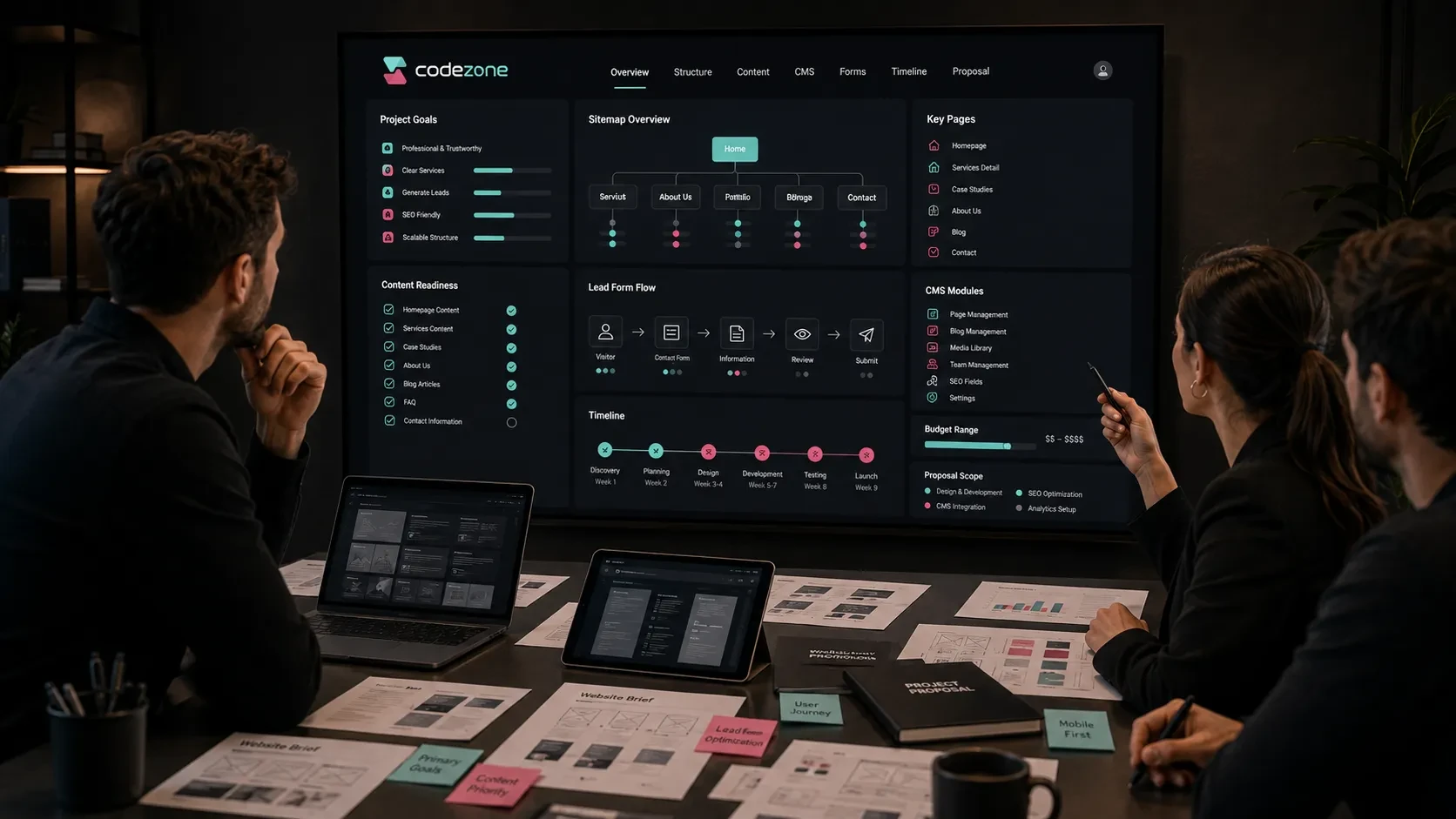
The Proposal Process Is Really the First Scope Discussion
Companies planning a corporate website often begin with a simple question:
“How much will the website cost?”
It is a reasonable question, but an accurate proposal first requires a clear understanding of what the project will include.
A corporate website can vary significantly depending on the number of pages, content requirements, design expectations, CMS structure, forms, editorial content, multilingual architecture, SEO foundations, integrations, and post-launch requirements.
The purpose of the proposal discussion is therefore broader than receiving a price.
It is the first opportunity to understand which business goal the website should support and what kind of scope is required to achieve it.
A well-prepared proposal process helps the company clarify its needs while giving the development team enough information to build a more realistic project plan.
Preparing several key decisions before the first meeting can make this process much more productive.
Define the Website’s Primary Goal
The first step is understanding why the website is being created or redesigned.
Corporate websites can serve very different objectives.
One company may want a more contemporary brand presentation that creates stronger trust.
Another may need a better landing experience for Google Ads campaigns.
Some companies want to explain their services more clearly, while others want the website to generate more qualified project inquiries through quote forms.
A Clear Goal Leads to a Clearer Scope
The website’s primary objectives may include:
Strengthening brand perception
Presenting services more clearly
Generating more quote requests
Creating a stronger foundation for Google Ads campaigns
Building an SEO-focused content infrastructure
Allowing internal teams to manage content
Creating a multilingual corporate website
Improving the speed and overall quality of an existing website
Supporting the launch of a new product or brand
The priority among these objectives directly affects project scope.
For example, a lead-focused website may prioritize service pages, CTAs, quote forms, and conversion tracking early in the process.
A brand-focused website may place greater emphasis on visual direction, corporate storytelling, references, and page composition.
The clearer the primary objective becomes, the easier it is to determine which areas deserve the most attention during the project.
Create a Rough Page Structure
One of the most useful pieces of information when preparing a corporate website proposal is the expected page structure.
The number of main pages, the way services are separated, and how content will be grouped all influence the project scope.
What Could a Basic Page Structure Include?
A starting structure for a corporate website may include:
Home
About
Services
Individual service pages
Projects or references
Blog or articles
Frequently asked questions
Contact
Quote request
Legal pages
This structure will naturally differ between companies.
A manufacturer may need product groups.
A consultancy may benefit from industry-specific pages.
A software company may separate its services into several core categories.
A healthcare brand may need specialist profiles, expertise areas, and team pages.
Service Pages Deserve Particular Attention
Service pages play an important role in turning corporate website visitors into potential customers.
This is where users try to understand which service is relevant to their needs.
Before requesting a proposal, it is therefore useful to decide whether all services will be presented on one page or whether individual service pages will be created.
The number of services, the depth of content, and whether each service needs its own CTA can all affect the project scope.
Decide Who Will Prepare the Content
Content can become just as important as design and development in a corporate website project.
Even when the page structure has been defined, the project still requires headlines, descriptions, service copy, visual assets, and a clear brand narrative.
Before the proposal stage, questions such as these should be discussed:
Will content from the existing website be reused?
Will new content be created?
Who will write the service descriptions?
Will the brand voice be updated?
Are the required visuals ready?
Will team or executive photography be used?
Will reference projects be published?
Will the website include a blog or article section?
Is multilingual content required?
Content created entirely by the client, content edited by the development team, and content developed collaboratively all create different project processes.
This responsibility should therefore be clearly defined in the proposal.
Website content should be treated as an integral part of the project rather than as empty sections that can simply be filled after development is complete.
Early content planning creates a smoother relationship between design, page structure, and launch preparation.
Define the CMS Requirements From the Beginning
If the company team will update the website after launch, CMS requirements should be discussed before the proposal is finalized.
The CMS is the management environment that allows the company to update website content without depending on developers for routine changes.
Which Areas Should Be Manageable?
Depending on the website, the CMS may include management for:
Blog articles
Service content
Reference projects
FAQs
Team members
Images
Page titles
SEO fields
Form submissions
Announcements
Multilingual content
Every area does not necessarily need to be editable.
The important question is which content the internal team will realistically update.
A company publishing articles regularly may need a more comprehensive editorial system.
A brand that frequently updates its projects may need reference management.
A company whose website content changes only occasionally may be better served by a simpler CMS structure.
You can explore this topic in more detail in our guide on how to choose a CMS for a corporate website.
Plan Forms and the Lead Journey
If the corporate website is expected to generate customer inquiries, the form structure should also be defined before the proposal stage.
Will the website use only a simple contact form?
Will there be a more detailed project or quote request form?
Will enquiries be delivered by email, stored in the CMS, or transferred directly into a CRM?
Areas to Define for Forms
Important questions may include:
Will there be a contact form?
Will there be a dedicated quote request form?
Will users select a service?
Will the form ask for a budget range?
Is file upload required?
Will there be a thank-you page?
Will form submissions be tracked as conversions?
Will enquiries be transferred to a CRM or email platform?
Will WhatsApp or phone CTAs be included?
Form structure directly influences lead quality.
A very short form may generate more submissions but provide limited information about the project.
A very long form may create unnecessary friction.
The right balance depends on the company’s sales process and the information needed before beginning a conversation.
For a deeper look at this area, you can read our guide on how to structure a quote request form on a corporate website.
Mention Multilingual Requirements Early
If the corporate website will be published in English, German, Arabic, or other languages in addition to Turkish, this should be discussed from the beginning.
A multilingual website involves more than translating text.
It can affect:
URL structure
Navigation
CMS architecture
SEO fields
Language switching
Form routing
Content relationships
Blog or article structure
Text used within visual assets
Technical architecture
For example, a website available in both Turkish and English generally needs corresponding versions of each relevant page.
Some content may differ between markets.
Certain services may only be relevant in specific regions.
These decisions should be reflected in both content architecture and CMS planning.
You can read more about this structure in our guide on how to structure a multilingual corporate website.
Prepare a Short Brief Before Requesting a Proposal
A short preparation list can make the first website discussion significantly more productive.
Useful information to share may include:
Company and industry
Primary objective of the website
Current website URL
Reference websites you like
Expected main pages
Service or product groups
Current content status
CMS requirements
Multilingual expectations
Form and lead flow
Integration requirements
Target launch date
Approximate budget range
With this information available, the software team can evaluate the project more accurately.
The first conversation can move beyond a general introduction and focus directly on actual requirements, scope, and next steps.
Codezone’s Approach
At Codezone, we approach the corporate website proposal stage as the first step in defining the project.
We use this process to understand what the company wants to communicate digitally, which business goals the website should support, and what kind of structure will create the strongest foundation for those goals.
Before preparing the proposal, we define the main objectives, page architecture, content status, design expectations, CMS requirements, form journeys, multilingual structure, timeline, and budget range together.
This turns the proposal into a clear project recommendation built around the company’s actual needs.
The result is a stronger shared understanding of the scope and priorities before design and development begin.
Conclusion
A corporate website proposal becomes much more useful when the primary goals, page structure, content, design expectations, CMS requirements, forms, multilingual architecture, timeline, and budget range have been discussed in advance.
This preparation does not mean every decision needs to be finalized before the first meeting.
It creates enough clarity for the conversation to become more focused, realistic, and productive.
A corporate website is one of the company’s main digital touchpoints.
The proposal process should therefore be treated as the beginning of defining the right project scope, rather than simply as a step for receiving a price.
Frequently Asked Questions
What information is needed to request a corporate website proposal?
Company information, the website’s main objective, expected pages, content status, design expectations, CMS requirements, multilingual needs, form requirements, integrations, timeline, and an approximate budget range can all help define the proposal.
Does all website content need to be ready before requesting a proposal?
No. The complete content does not need to be finished. However, it should be clear whether existing content will be reused, new content will be created, and whether content support will be required as part of the project.
Is it necessary to share a budget range?
Sharing an approximate budget range helps the project team recommend a scope that is better aligned with expectations. The same website requirement can be structured differently across different budget levels.
Does a multilingual website affect the project cost?
Yes. A multilingual structure can affect the number of pages, CMS management, URL architecture, SEO fields, content preparation, and testing requirements, so it should be included in the project scope from the beginning.
What fields should a quote request form include?
Depending on the company’s sales process, the form may include name, email, company, service selection, budget range, project description, and additional information. The structure should collect enough context to support a qualified first conversation.